Everything I put up on Wikipedia gets wiped so I am putting it all up here in my own way -- mostly stuff that Wikipedia does not have in English. Mainly information about operetta but some other topics as well
Tuesday, April 21, 2015
Jesus Christ Superstar
I saw a live performance of A.L. Webber's "Jesus Christ Superstar" in Sydney back in the '70s. Many church people were critical of it at the time but I thought then, as I still do, that any promulgation of the Gospel message was valuable. It is a great message of hope and kindness. I no longer share the hope but perhaps some of the kindness has stuck.
So when I recently saw in Target a DVD of the show for $5, I thought it a good purchase. It is the Universal Pictures movie version from the year 2000.
And I can see nothing wrong with the story in the show either theologically or exegetically. There are even correct quotations from the scriptures at crucial points. The main emphasis of the show is on the passion, the times immediately leading up to his execution. And the mental agonies that he is portrayed as undergoing at that time are perfectly scriptural, though much enlarged on. Read Matthew chapter 26 if you doubt it. My old Bible opened at that spot very easily when I went to check it.
So I think Webber has done the world a service in introducing the Gospel story to a "rock" audience. He must have reached many that the churches did not.
The casting: Political correctness was already alive and well in the year 2000 so the cast included a lot of blacks. Maybe there were a lot of Ethiopians in the Jerusalem of Jesus' time that we have not heard about. There are certainly a lot there now.
But the times seem to get ever more sensitive so I imagine that if the movie were a current release it might get some flack over its casting of a black as Caiaphas. According to the Gospel accounts, Caiaphas was the major antagonist of Jesus. He was the villain of the piece, in short.
And the casting of Jesus was unrealistic too. He was cast as a tall, well-built man with flowing and curly red hair. In life he would have been a short, stocky man with black hair, dark eyes and swarthy skin, as most Middle-Easterners are to this day. But the casting was pretty close to traditional depictions of Jesus. It was rather odd that he was the only one wearing a nightgown, though.
I must confess that I found the casting of a light-skinned "black" woman (Renee Castle) as Mary Magdalene rather jarring. I can take only so much anachronism. And her rendition of "I don't know how to love him" amazed me by its poverty. She had a very weak and girlish voice. I would have liked to hear that aria from a soaring operatic mezzo. Helen Reddy did it pretty well, though.
I am inclined to make a few comments about the translation of Die lustige Witwe. The usual translation is "The merry widow" and I suppose that is close enough but "gay" or "pleasure-seeking" would approximate it too. "Lustig" is not "lusty", however. It is about having a good or entertaining time.
I was delighted recently to receive a DVD of the operetta by Lehar of that name which featured Dagmar Schellenberger as the leading lady. After her performance as Mariza at Moerbisch I expected some brilliant singing and acting and I was not disappointed.
The performance was from Zuerich in der Schweiz, in the Zurich opera house -- and that made clear to me how Moerbisch spoils us. The high tech facilities at Moerbisch enable lots of very sharp and very close close-ups -- rather like in a Hollywood musical. So facial expressions can be seen in great detail. The technicians at Zurich were no slouch but broadcasting from an ordinary opera house did limit them, with the lighting apparently being the main culprit.
So the brilliant expressions that Schellenberger is known for were at their clearest only when she was under bright light. Lighting varies in opera houses so clarity was on other occasions reduced. There was not the constant clarity to be found at Moerbisch. What was particularly missing was Schellenberger's eyes. She has the most expressive eyes and one could not always see them at critical junctures. We saw enough of her, however, to marvel yet again at how well her face mirrored what was going on. She has the most amazing range of expressions -- and all used appropriately to the story. I liked it when she answered her difficult man with just one glance of her eyes.
And it's not only facial expressions. Her gestures and body language are eloquent too. Her body language when she was urging the dummer Reitersmann to claim her was a legend-quality example of non-verbally saying "take me".
And the very different role did call forth from Schellenberger a new lot of expressions. This time she brilliantly conveyed disgust, pique and coquettishness -- among much else. Her singing was as good as ever but the role did not really stretch her -- though she did belt out a few high notes for fun on occasions.
But it was a fun operetta and I will be watching it repeatedly. It gains with each successive viewing of course. The local patrons at the Teatro alla scala in Milano know that. They normally know well the opera put on there but keep going along to absorb more of it.
I initially thought that Schellenberger looked younger than she was at Moerbisch but, on checking, I found that both performances were in 2004! It shows how much difference hair, makeup and clothes can make. And her role was quite different too. At Moerbisch she was the haughty lady who fell in love against her better judgement whereas at Zurich she was the pretty and clever little lady who was determined to get her man. And, this being operetta, she did, of course. The man didn't have a hope. Whether she IS the ultimate female or not, she certainly plays one with great conviction.
The Swiss were a bit more daring in the costume department too. Both Schellenberger and Ute Gfrerer showed noticeable cleavage, particularly so in the case of Gfrerer. Gfrerer was the second lead, playing Valencienne, the attractive young singer married to a rich older man.
Gfrerer seems to be a rather jolly lady in general but her part in this show was almost wholly serious. She was even asked, rather absurdly for her, to be Eine anstaendige Frau (a respectable wife). I was inclined to think that her notable bosom was what got her the part and that may have been so. It did suit the role. But she is also much acclaimed as a singer and actress. There is a bio of her here.
Her natural talent for gaiety did however surface in the dancing. She was in any dancing going, whether the part really called for it or not. She even led the cabaret dancers towards the end of the show. With big smiles and shrieks, her happiness throughout the dancing was a joy to watch. She even got herself tipped upside down in that last segment! She is a naturally happy lady, I think. And being born both beautiful and talented why should she not be happy?
Ute Gfrerer
Schellenberger with the ambassador
Schellenberger with her "difficult" man
In fact Zurich got top talent all round. Even the conductor has a distinguished record. He was Franz Welser-Moest and when I saw him I thought he was rather young as conductors go -- but I was mistaken. He was in fact 44 at the time. A lot of German men are ageless for a long time and he is obviously one of those. Something to do with the climate, maybe. I was at a conference at Oxford once when I saw a New York lady mistake a good-looking German man as being about 30. He was closer to 50.
The music was of course good so it seems a pity that none of the arias seem to be much used outside the context of the operetta itself. Some of the tunes might even reasonably be described as catchy. Vilja gets a very occasional airing as a concert piece by itself but even on YouTube most of the renditions are extracted from stage performances of the operetta.
The inescapable Andre Rieu has of course grabbed it for his shows and in fact done rather well with it. He has up a very sweet rendition by a slightly built black South African soprano named Kimmy Skota. She does not of course have a fraction of Schellenberger's facial expressions but the singing is as good as any. I find it hard to evaluate Schellenberger's performance of the aria as just singing. I can't isolate the singing from the brilliant way she plays the part as a whole.
The stars of the show were undoubtedly the two ladies above but Njegus the majordomo was a great comic touch too. And Rudolf Hartmann made a great comic figure out of Baron Zeta.
And I must of course say something about the big and mellifluous American baritone, Rodney Gilfry, who has learnt enough Hoch Deutsch to play Graf Danilo well. His rugged good looks do make him credible in the part as much admired by women but he is quite powerless against the the German ultra feminine Schellenberger. Schellenberger has been described as "Prussian energy plus feminine charm" -- and there is a lot to that. A real-life man could not withstand her for 5 minutes.
And the two little voiceless sobs she does in the humming song are immensely evocative, though I do think they are a bit of a trademark for her. She is one clever lady.
A small language note: The honorific Russian form of address "Gospodin"/"Gospodina" is used on occasions in the show -- presumably to identify the mythical country in which the show is set as Slavic (clearly modelled on Montenegro). It means "Your honour" or "Gracious lady" or something along those lines. It is perhaps a bit less empty than the German expression "Gnaedige Frau" (which is also used).
Speaking of expressions, it is mildly interesting that women in German lands rarely refer to their husband as a husband. They refer to him as "mein Mann" (my man). There is a German word for husband (Ehemann) but it seems to be little used. And Frau (woman) is also used to mean "wife".
Another language note: As the anstaendige Frau is a recurrent theme, I thought I should elaborate a little on the meaning of anstaendig. It is reasonably translated as "respectable" but it is also often translated as "decent". It is a claim about her good character as well as a claim about her good reputation. On one occasion she describes herself in French as a femme d' honneur and I think that best captures what is intended for the part. It means a "woman of honor". Interesting that the old Latin word honor is still used in both English and French with the same, original meaning. I am mildly regretful that the Old English word mensk has been completely supplanted by it.
I was a bit peeved that the French used in the show was subtitled but not translated. I haven't spent one minute studying French. But, fortunately, my general knowledge of European languages enabled me to get most of it.
The words of all the songs in the show are here -- in German AND English
Finally, is there a political message in the operetta? Patriotism is rather clearly held up to ridicule in it but is Lehar ridiculing Austro/Hungarian patriotism, the patriotism of small countries or ridiculing patriotism generally? I will have to read further on that, I think. He was not himself Jewish but his wife was and he associated a lot with Jews so that may have made him skeptical of the patriotic sentiments of the time. On the other hand he spent a lot of his early life in the armed forces, which usually encourages patriotism. On balance, I am inclined to suspect that he saw Austro/Hungarian patriotism as excessive. His near contemporary in England, W.S. Gilbert (in the Gilbert & Sullivan light operas) was certainly no respecter of the establishment.
Saturday, April 4, 2015
Kalman's Graefin Mariza at Moerbisch in 2004
A few more notes about the 2004 performance at Moerbisch of Kalman's Graefin Mariza. I have already written a bit about it but I think I should add a few things that might, via the magic of Google, be helpful to people looking for more information about it. There is very little available in English about it online so far.
I think I have watched the show every night since I got the DVD some weeks ago. It is to me great entertainment and also a perfect work of art. I even still laugh at jokes that I have heard around 30 times already! The combination of Kalman's music and the no-expenses-spared staging at Moerbisch is hard to beat. I love the Moerbisch steam train.
And, in the usual way for operettas, the show is exceedingly romantic. Love is its theme. So why the Devil do I enjoy it? I see myself as one of the world's least romantic persons. But as the ancient Greeks used to say, "It's a wise man who knows himself" and the fact that I have been married four times may be some evidence of that. And I still think that I married four very fine ladies.
Lots of good excerpts below;
But if you want English subtitles you will have to buy the DVD. The words are of course in German, but the music is international.
The producers of the show never resolved the conflict between representing the period of the show as either the 1920s when it was written or the late 19th century in which it is set. There were also a few references to modern times, but mainly for humorous effect. I was rather pleased that a passing reference to the EU got a big laugh. It is a bureaucratic monster that needs to be laughed at.
The story
The story is that an Austro-Hungarian lady (Mariza) is plagued by so many suitors that she retreats to her estate in Hungary on the pretence that she is going to get married there. She has however an elderly suitor who follows her to her estate. Her estate manager (Herr Toerek) is in fact an impoverished aristocrat and she (of course!) falls in love with him. But then there is a big misunderstanding that has to be resolved.
The second-string story involves involves a rich Yugoslav estate owner, Baron Zsupan, and the sister of "Herr Toerek". She wants him but he initially thinks he wants Mariza. When he finally realizes that he really wants the sister he has the devil of a job getting her back.
The cast
Moerbisch is such a prestigious venue in the world of operetta that the organizers must have had just about untrammeled choice among all the many singers of the German lands. Germans did terrible things to themselves (and others) in two world wars but artistic talent still abounds there. So the directors at Moerbisch could demand performers who were both brilliant singers and great actors -- and pretty good dancers too. And in 2004 they got all that.
And Dagmar Schellenberger as Mariza was the first among greats. Her brilliant acting and rich soprano voice rather mesmerize me. Her acting would be taken as over-acting at Hollywood but it was perfect for operetta, where realism is secondary to a great show. I enjoy her amazingly expressive acting as much as her faultless singing. She has exceptionally expressive eyes. Her facial and bodily expressions are perfect for every moment of the story and convey almost as much as her singing. She does hauteur, anger and ecstasy equally briliantly.
And I loved the comic performance by Marco Kathol as Baron Zsupan almost as much. He is a very good tenor who, unusually, was also a ballet dancer for some years. And his dancing background shows. His moves are so fleet and flexible that they are a wonder to watch. He must have been a pretty good ballet dancer too. He is a pleasure to watch.
And he is obviously still very strong and fit. He picks up Schellenberger as easily as if she were one of the wispy little ladies of ballet. And Schellenberger looks to be a fine figure of a woman, almost a "big bizzem", as they say in Scotland. When the character Penizek later in the show checks out her "architecture" he had reason to be pleased with what he saw. For most of the show she wears heavily "glammed up" clothes that rather disguise her body but when she gets into her milkmaid Tracht towards the end of the show she looks very good indeed.
In another operetta, Die lustige Witwe, we find the meaning of "architecture" spelled out a little more -- as a good mezzanine and a good balcony. I think we get the drift.
All of the singers in the show performed their roles very well but it is Schellenberger and Kathol who cause me to watch it again and again. After watching the show many times I now laugh the minute I see Kathol roll onto the stage on his railway handcar.
The songs
The best song of the show is undoubtedly the Varazdin song. It is very catchy. But until you try to sing it you don't realize that it is a tongue-twister too. Kathol and Schellenberger to well to gallop energetically through it. When I try to sing along I can't do it. I always stumble over Gulaschsaft (goulash juice). The words are below:
Komm mit nach Varazdin! So lange noch die Rosen blüh'n,
Dort woll'n wir glücklich sein, wir beide ganz allein!
Du bist die schönste Fee, von Debrecen bis Plattensee,
Drum möcht mit dir ich hin nach Varazdin!
Denn meine Leidenschaft, brennt heisser noch als Gulaschsaft
Und in der Brust tanzt Herz mir Czardas her und hin!
Komm mit nach Varazdin, so lange noch die Rosen blüh'n,
Dort ist die ganze Welt noch rot, weiss, grün!
The "rot, weiss, grün" (red white and green) refers to the colours of the Hungarian flag. The operetta is set in a grand Hungarian estate.
The male lead in the show has some good arias, with "Komm Zigan" being particularly dramatic, but none of them stuck with me the way the Varazdin song did.
The inhabitants of the fine city of Varazdin in Northern Croatia are probably not too keen on the song as it portrays Varasdin as home to 18,000 pigs -- when Varazdin has much grander real claims than that.
Other details
It took me a long time to figure out what the luminous blue ball was all about but I think I finally get it. It represents the moon. The gypsy woman "Manja" prophesied that in one lunar cycle Mariza would find love. And when they do acknowledge their love they hand the ball back to Manja. The lunar month is over. And at that point Serafin reappears to mark the end of the month.
And if you know a bit of history some strange things happen. When Mariza asks Herr Toerek, "Haben Sie einen Frack" he replies affirmatively. But nobody in the show at any time wears a late 19th century Frack. A late 19th century Frack was what was known in English as a frock coat, a long coat that belled out slightly towards the bottom. It was not cutaway. You occasionally see them on gamblers and the like in cowboy movies. In Graefin Mariza formal dress is the more modern Frack of the 1920s, a tailcoat. The producers of the show kept the original words but not the period dress. The subtitle translators rendered Frack as "dress-shirt", which is simply wrong. "Evening clothes" would have been better.
And I should say something about the Puszta. It is mentioned quite a lot both at the beginning and the end of the show. In the subtitles, it is sometimes translated (as "prairie") and sometimes not. As Wikipedia informatively says: "The Hungarian puszta is an exclave of the Eurasian Steppe". It is a large area mostly of grassland with rather infertile soils -- but the interesting part is the people who live there. Wikipedia doesn't tell you about that. It's a hard life there and it breeds a tough people. And it is the women of the Puszta who are idolized in Graefin Mariza. They are seen as particularly lively and attractive -- and, one suspects, rather easily seduced by rich Hungarian men.
Hungary generally is in fact greatly romanticized by Kalman. And not only mainstream Hungarian society but also the Hungarian gypsies are extolled. Gypsy music is in fact to a large degree the focus of the show. But gypsy fortunetelling is treated with respect, as are gypsy dancers. Why was Kalman so enthused by gypsies? It's got to have something to do with the fact that Kalman was a Hungarian Jew (born Imre Koppstein). Antisemitism was already rife in Vienna and elsewhere when Kalman was writing -- Nazism arose in fertile soil -- and it must have freaked him. So was he trying to claim a new identity for himself? Perhaps. He always seems to put some scraps of his native Magyar (Hungarian language) into his show and there were a few small bits in this show -- Jonapot etc.
There is a lot to note about the language in the show. It took me a while to figure out what was going on when the word Zigan was used. When sung, it sounded like Sieger (victor) to me but I eventually figured out that it was just an abbreviation for Zigeuner (gypsy).
And at one point we get a bit of Serbian, the most widely-spoken language in the Balkans. In the wrap-up scenes at the end of the show the rich aunt from Southern parts repeatedly addresses her long-lost lover as "Dragi", which sounds a bit harsh to English ears. It just means "Darling".
And a curiosity about the language was a roughly 50/50 split over where the emphasis should be placed on Mariza. Is it MAHriza or MahRITza? Schellenberger pronounces it the latter way but others do not. So either way is "correct".
Translation issues
There is quite a lot of wordplay in the show but you miss most of it unless you know some German. One thing that struck me as odd was when the majordomo opined that Bela Toerek was named "Bela" because he was good looking -- an allusion to the Italian "bella", meaning beautiful. But Bela is a common Hungarian Christian name and Hungarian is unrelated to other European languages so how could he think that? Apparently there is no agreed meaning for the name "Bela" so he was at liberty to make a romantic speculation about it.
And the split between Northern and Southern German pronunciation is referred to. Northern Germans tend to look down on Southern Germans but Southerners don't give a damn about that. And Fuerstin Cuddenstein, the rich aunt, is portrayed as speaking in a broad Southern way. Like the Swiss, she says "Daitsch" instead of "Deutsch". So she brings her German teacher, a former thespian, with her to "improve" her speech.
The translators do a manful job of turning German into English but the translations are quite "free" (non-literal). I don't underestimate their difficulties, though. German and English were the same language 1500 years ago but a lot has changed since then. And the two languages do to an extent cut up reality in different ways these days. I have made a few notes about that from my days translating the German of Karl Marx and Adolf Hitler into English. A lot of what those two gentlemen said during their lives poses difficulties for the modern political Left so had not been available in translated form online. So it was amusing for me to let the cat out of the bag.
So all that adds up to the fact that you get a lot more out of the show to the extent that you understand German. Translations just cannot do the whole job of conveying the original intention of the text. One instance of that occurs when the Graefin is declaring her intention to stay on her Gut (estate). To deter any opposition to her decision,she adds, "sicher und sicher". That is certainly very emphatic in German and Schellenberger's facial expression says more than words probably could anyway. But sicher literally means firm or secure so you cannot translate it well directly. You have to use a circumlocution. And no circumlocution that I can think of is as emphatic.
And there is in the subtitles what I regard as a major mistranslation. Verwalter is translated as "bailiff", which mostly means an official of a law court these days. The German literally means someone who exercises power on behalf of someone else so a simple "manager" would have been better.
So I hope that my various comments here about things in the show will help to a small degree to make up for any lack of German in those who view it.
Mariza falls for her Verwalter
Harald Serafin, Schellenberger and the purloined letter
Schellenberger in her milkmaid Tracht
On to the politically incorrect bit!
Anne watches a lot more ballet than I do and Russia is of course a ballet powerhouse. You only have to see magical performances such as that by Ekaterina Kondaurova as the Firebird at the Mariinsky Theatre in St Petersberg to know why. And Anne remarked to me recently that she has never seen a black or Asian face in a ballet performance from Russia. All the faces look like the faces we both grew up amongst. You cannot usually tell one Northern European face from another just by looking at them. A Russian could be an English person for all that looks give away.
And I notice the same in the performances I have seen from Moerbisch. I have not seen them all so maybe there has been some "diversity" there at times. It's actually a bit of a shock to see someone who could be the person next door speaking very foreign-sounding German words.
But perhaps an old guy like me may be permitted to be pleased to be watching faces like those he grew up among.
Friday, March 27, 2015
Emerich (Imre) Kalman
Who the Devil is Emerich Kalman? His name goes close to being totally forgotten these days but in the first half of the 20th century he was much acclaimed. His music was so popular that Hitler even offered to make him an honorary Aryan (Kalman was Jewish) -- an amazing distinction, whatever else it was. Kalman declined the offer and got out of Europe while the going was good.
But there is one place these days where he has not been forgotten: Moerbisch. Moerbisch is as near as you can get to being the world headquarters of operetta. Situated by a lake in Austria's beautiful Salzkammergut (Lake District), Moerbisch is to operetta as Bayreuth is to Wagner. Performances at Moerbisch are lavish. Huge sums are spent on them to make them as good a performance of the work concerned as you can possibly get.
And the audience at Moerbisch is amazing in its vastness. When the cameras cut to the audience you can see that their claim of huge audiences is fully believable. The audience goes on forever. It looks like half of Vienna is there. Does any other stage performance have an audience that big? I know of none. Perhaps in Russia.
The Moerbisch performances might almost be called "definitive" performances except for one thing: No two stage shows of any kind are ever the same (except perhaps for Shakespearean performances). The original script is taken as not much more than a set of suggestions in many cases. The producer on each occasion feels free to cut bits out and put new bits in. And for the light entertainment that is operetta that is particularly so.
That seems to me disrespectful of the talent that made the show notable in the first place but it can help by making a show more relevant to a particular time and place. And the great resources of all kinds now available in the early 21st century greatly expand what can be done -- things that would probably not be dreamed of by the original author -- but which do expand the watchability and impact of the show.
And having the great resources of Moerbisch applied to an operetta by Hungarian composer Kalman certainly produces very good musical theatre indeed. I have recently watch the 2004 Moerbisch performance of Kalman's Graefin Maritza and was quite gripped by it. The plot of the play is the sort of folly you expect from operetta -- with everybody living happily ever after by the end of the show -- but the acting and the singing were as good as can be.
And Kalman's music was both lively and inclusive of some very catchy songs. I am in fact rather amazed that the Varasdin song is not better known. It is very fun and catchy indeed. The inhabitants of the fine city of Varasdin in Northern Croatia are probably not too keen on the song as it portrays Varasdin as home to 18,000 pigs -- when Varasdin has much grander real claims than that.
Tenor Marko Kathol leads the Varasdin scene and I was much impressed by his talent. I have watched that scene over and over again. With Kalman's music and the spirited performances by both Kathol and the "Graefin" (Dagmar Schellenberger), it is so beautiful. I have looked Kathol up and it seems that others share my very favourable impression of his abilities. That he is a former ballet dancer certainly shows in the flexibility with which he moved at Moerbisch
Viennese operetta has a sort of frantic gaiety about it. A lot of it was written in the aftermath of the ghastly WWI and no city was more impacted by that war than Vienna. It lost something like 90% of the territory it once ruled. But, being the city of music, Vienna rose to the occasion and produced entertainment that both lightened the spirits and took people back to happier days. The operettas are usually set in the prewar period. They have left a great musical treasure for us all.
You can view the marvellous Varasdin song ("Komm mit nach Varasdin") below:
There is a nice picture below of the very expressive Dagmar Schellenberger in her role as the Graefin at Moerbisch in 2004. She is both a most accomplished soprano and a superb actress.
UPDATE:
I am a great fan of Schellenberger. I have even put up a fan site for her. She is a fabulous and expressive woman as well as a great Saxon soprano. And in operetta it helps if the ladies are good-looking. And Schellenberger is. We actually see more of her in Die lustige Witwe but IMHO she looks best when she wears Tracht -- towards the end of this show. The big skirts of country Austria do seem to be flattering generally.
Wednesday, March 25, 2015
Fledermaus at Covent Garden
I have just watched (twice) the 1984 Covent Garden performance of Strauss's Die Fledermaus. The time travel concerned was made possible by a DVD.
Hermann Prey and Kiri te Kanawa pictured in the finale
The Royal Opera House at Covent Garden is everything you expect of an Opera House -- a large and ornate building that gives the impression of a no-expenses-spared project. I was pleased to see the the stage curtains featured prominently the Royal cipher (EIIR).
The opera itself was brilliant entertainment, with lots of laughs in it, particularly in Act 3. It was almost as madcap as Gilbert & Sullivan (NOTHING can be as madcap as Trial by Jury). It well deserves the innumerable performances that have been done of it.
Perhaps because of my interest in languages, the scene that amused me most was when the husband and the jailer were introduced as Frenchmen and they had to pretend to speak French to one-another even though they knew just about as much French as I do, which is very little. They managed a few common but totally unconnected French words and even threw in a bit of Italian.
Quoting excerpts from earlier operettas in a new operetta seems to be rather commonly done. Nobody seems bothered about plagiarism. So when Prey burst into a good rendition of Flotter Geist (from Zigeuner Baron) during the party entertainment segment it was simply appreciated as a good performance. I imagine he has sung the whole of that part on occasions.
Mein Herr Marquis
Another amusing reference was in Act 3 when the drunken jail warder asked the conductor to play the music for a Radames aria from "Aida" so he could sing it. He made a hash of it of course but the conductor was the omnipresent Placido Domingo, who has sung the part of Radames on many occasions, so we had the odd and amusing sight of the conductor singing along to help out a singer with a song. Very creative!
And a big surprise was the appearance in the party entertainment segment of every woman's favourite soulful singer -- "Sharl" Aznavour -- playing, what else, Charles Aznavour. To get him along in a cameo role was undoubtedly a bit of a coup for the production. You don't have to understand a word Aznavour sings to get the soulfulness. He is a mobile evocation of tragedy. He is not my cup of tea at all but he is undoubtedly a supreme master of his genre.
And the dancing was surprisingly good too. The dancing in operas and operettas can be pretty basic. I have an example in mind -- from Britain -- but will not be so unkind as to record it. So when the ballet company floated into the party entertainment scene it was a real pleasure
The chief male dancer impressed me. It is of course routine for male dancers to lift the ballerina above their heads at some stage, though few have been as good at it as Nureyev. He would lift the lady up with two hands and then hold her there briefy with one hand -- a great feat of strength. And the dancer on this occasion was even better. He exited holding the ballerina above his head -- with his grip on just one of her ankles. Just holding her there would be pretty good, let alone walking off with her like that. Update: On further viewing he seems to have a hand on his lady's bottom too. But it is still quite a feat.
And where did the director get the "two old ladies" segment? It seemed straight out of vaudeville. Does vaudeville still exist somewhere in England? Maybe in the clubs. It was very amusing.
And I was rather pleased at how un-Islamic the show was. It featured a huge amount of alcoholic imbibing and not a little of amusing drunkenness. Towards the end the whole proceedings were said to be a celebration of Champagne! I think I too would blow myself up if I were a Muslim.
Speaking of 21st century concerns, I was pleased at how good the ethnic stereotyping was in the casting. Ethnic stereotypes are absolutely verboten these days but they have been something of an interest of mine. I have even written academic articles on the subject (here and here). So I was pleased to see that the Italian music master could not have been more Southern Italian in appearance and manners: A Neapolitanian, I would have thought. But he was in fact Welsh-born Dennis O'Neill. Maybe his dark eyes and heavy eyebrows helped. And I was initially a bit critical of "Dr Falke" looking so English -- but I note now that he is introduced as "from London" -- so the casting director and I obviously thought similarly. And Hermann Prey looked as German as he is.
The performance as a whole was a distinguished one indeed. Getting Kiri te Kanawa as leading lady was a coup and she was at her very good best. She both sang and acted admirably. Though in the acclaimed czardas scene it seemed a bit strange to me to have a half-Maori lady proclaiming her passionate love of her Hungarian homeland!
Kiri singing Klange der Heimat
I guess my interest in ethnic matters betrayed me there. And Hermann Prey as the husband was in his element. His expression when his wife was expounding his sins in Act 3 was very well and amusingly done.
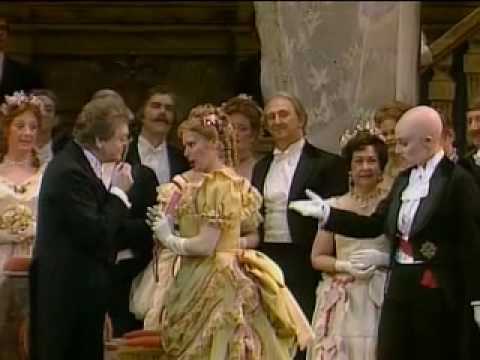
So what did I not like about the production? I LOATHED the "trouser role", where the Prince was played by a bald-headed woman. The role was originally written that way but I am obviously not alone in my response to it -- as quite a lot of productions have put a man into the role. And couldn't they at least have put some hair on her? A bald-headed woman is a tragedy. The lady sang well enough but looking at her was a pain.
I suppose the producer at Covent Garden was being true to the text in casting that role but I wish he had been true to the text throughout. He clearly couldn't decide whether to produce the show in German or English. It was mostly in German but also substantially in English. Because I have a degree of age-related hearing loss, I understood the German better -- because it had subtitles -- while the English did not. The English bits were mainly to get laughs -- which succeeded -- but why not be done with it and produce the whole thing in English? Kiri te Kanawa is of course a native English speaker and I can't imagine that the other singers would have had any difficulty.
Many patrons of the arts are elderly and reduced hearing is a normal part of aging so all recordings of operas and operettas should be fully subtitled, just as all live performances should include supertext.
And whatever limitations the show had were all more than made up for by Strauss's wonderful music. The profundity of J.S. Bach is my musical home but you would have to be a sad soul indeed not to hear the joy that is in the music of Johann Strauss II.
Anybody interested can watch the whole thing online here -- with subtitles.
UPDATE from May, 2015: I have just watched the show again and am even more grouchy about the trouser role this time. I can see absolutely no artistic merit in having a bald woman in that role. Major performances of operetta usually have quite masculine-looking men in important male roles. I looked aside for most of the time when she was in focus. Opera directors have substantial interpretive leeway so it seems a pity that this folly was continued. Though maybe he would have risked the wrath of feminists if he had changed it.
Why did Strauss specify a woman for that role? There were frequent tensions between Austria and Russia around the turn of the century -- tensions that eventually gave us a world war. So maybe casting a bald woman as a Russian prince was meant to be derisive, a derisive comment on Russians. If so, it seems regrettable that a now obsolete political statement has been continued.
The ending was a trifle outside operetta conventions. Normally at that point all the separated lovers get together and vow marriage. But on this occasion the leading couple were already married. Their marriage was however under tension as a result of the machinations of the bat so the ending consisted of the couple reaffirming their married bliss. Only a touch outside convention!
Before I close off my comments here I am however going to mention something totally wicked -- something that will damn me to Hell for all time: Sex appeal. How dare anybody introduce a Hollywood term into a discussion within the world of Austro-Hungarian operetta?
But I am going to do it. IMHO none of the ladies in this show had sex-appeal. Kiri te Kanawa has a marvellous warm soprano voice, is a good actress and has pleasant looks -- but IMHO she has NO sex-appeal. There! I have said it, I have uttered a great blasphemy.
But this was of course an English production of something from deep in old Austria-Hungary. And when I think of Austrian or South German productions of THEIR operettas, I think of gorgeous ladies such as Zabine Kapfinger, Anja Katharina Wigger, Dagmar Schellenberger and Ute Gfrerer. Wigger is basically just a slim blonde but, in her 2008 performance at Moerbisch, she just oozes sex-appeal. So I can imagine a more appealing production of Strauss's wonderful creation.
Monday, March 23, 2015
Was Paganini a psychopath?
Paganini was a brilliant violinist in the 19th century but what else do we know about him?
Franz Lehar wrote an operetta about him called, unsurprisingly, Paganini. And the operetta seems to be pretty historically accurate as far as I can see. Paganini is portrayed as a compulsive womanizer and gambler, which he was. Even his gambling away his violin is historically accurate. So the operetta would seem to be an insightful recreation of the man.
And, given my psychology background I can say with confidence that what Lehar portrays is a psychopath, and a pretty reprehensible one at that. Psychopathy was one of my research interests during my academic career and I have had a couple of research articles on the subject published in the academic literature. See here and here. I have also written about it more recently here
Psychopaths very often have a magnetic appeal to women -- mainly because the psychopath tells the woman whatever she wants to hear -- whether it is true or not. And Paganini's approach to women is also just that. But psychopaths tend to become unglued when their lies become evident. And Paganini did. And the way the Princess sticks to him despite great disappointments is also very typical. Women are reluctant to abandon the wonderful illusion that the psychopath has created and think they can make it come true if they try hard enough. So if anyone would like to see how psychopaths do it, Lehar's operetta would be a good start.
In the circumstances the ending of the operetta has to be low key by operetta standards. The parties simply go their different ways. At least the death and damnation of an opera ending is not seen.
Saturday, March 21, 2015
Zigeunerliebe and GWF Hegel
I guess it shows what a hopeless academic I am that I could write the heading above. Only an academic would compare a Viennese operetta with a nigh-unintelligible Leftist philosopher. I guess they both spoke German. There's that to it.
In the late 19th century and early 20th century, there seems to have been some fascination with Gypsies as living "free" lives. You see it in Carmen, in Zigeunerliebe and Il Trovatore, for instance. Lehar's Zigeunerliebe has a somewhat minor place in operatic history but I was watching a 1973 cinematic version of it last night so it is in front of my mind at the moment.
Both Carmen and Zigeunerliebe feature a fascination with gypsy life. And the portrayal is fairly similar in both cases. The major difference is that the ending is tragic in the opera (Carmen) and happy in the operetta (Zigeunerliebe). But that's basically the difference between the two art-forms. In some operettas there are THREE happy couples at the end (e.g. Der Graf von Luxemburg and Im weissen Roessl) so Zigeunerliebe is actually rather morose in having only one. The scheming old father was apparently seen as not deserving of marital bliss.
Both Carmen and Zigeunerliebe are quite moral tales. They say that a desire for freedom can be strong but freedom is in the end illusory -- or at least has a lot of downside.
Which brings me to GWF Hegel -- who thought the same. Hegel was of course the philosophical inspiration of both Karl Marx and Adolf Hitler but still seems popular among the small number of Leftists who are capable of thinking at any depth. And you DO need to be a deep thinker to follow Hegel. His writings are a real struggle to follow. I gather that he gave satisfying lectures, however, and after people were inspired by his lectures, they made the effort of following his writings -- and so generally broadcast his name and fame. I have a more extended comment on his writings here.
But the problem Hegel and the opera characters were addressing is a real one. We all like to be free from restrictions but a moment's thought will tell us that rights connote duties. For example, my right not to be assaulted is everybody elses's duty not to assault me. Similarly, the opportunity Gypsies have to move around a lot makes it difficult for them to earn a living. They have to resort to some rather unpleasant work, such as begging and stealing.
Hegel, however carries that insight to an extreme degree. He basically said all freedom is an illusion. Being a philosopher, however, he did not actually deny freedom. He redefined it -- saying that the only freedom was freedom to march in lockstep with everyone else. His idea of freedom was the freedom of the ant. His model of an ideal human society was an anthill.
Fortunately, the English have always valued their individual liberties so Hegel's ideas were not widely accepted in England and its derivative societies. And both in England and elsewhere the 19th century also produced some good defences of individual liberties -- both in the persons of various economists (culminating in the thinking of Boehm-Bawerk) and in the very lucid philosophical writings of J.S. Mill. Sadly, Mill did not practice what he preached. His votes in the House of Commons were thoroughly socialist. Rather amazingly, he was a crypto-Hegelian. His On Liberty seems to have been just an intellectual exercise for him.
Fortunately the classical liberal ideas of Mill and others developed in the 20th century to thinking now known as libertarianism -- thinking which sets out in detail how a very much larger scope for liberty than we currently have can be achieved. And insofar as libertarian ideas have been applied (for instance in the policies of Margaret Thatcher and Ronald Reagan) the results have been very benign -- a stark contrast with the ideas of GWF Hegel.
So there is an answer to the opera characters and others who idolize the Gypsies: Freedom can never be absolute but we can go much further towards it than we so far have done.
So Lehar's Zigeuner Liebe was rather insightfully didactic. The glorification of gypsies was rather common in Austro/Hungarian operetta so Lehar used his great talents in an attempt to right the balance. In this show he first set out the attractions of the gypsy life, as conventionally conceived, and then showed its downside. And there was lots of good singing to make the lesson enjoyable
Didactic art can be very good (e.g. Dickens) but that tends to get subordinated to the message. And in this show there were very few jokes and no characters that one could identify with. Janet Perry is/was a very nice looking lady and a good singer but I certainly could not see much engaging about the thoroughly scatty woman she portrayed.
And I must comment on "Ilona". She was convincingly portrayed by Colette Lorand and she fitted exactly what my father would have called "An old bomb". I am not sure how widely that bit of Australian slang is understood but -- approximately -- it means an older lady who thinks she is still as attractive as she was in her youth and is rather arrogant and egotistical as a result: An unpleasant but realistic character. I quite loathed her. But in a characteristic Australian way I loathe pretention and egotism generally. It's "bunging on an act" and it's not "fair dinkum". I could translate those expressions but I think I already have.
So it was good a show but not one to return to very often.


 Ute Gfrerer