Background

Everything I put up on Wikipedia gets wiped so I am putting it all up here in my own way -- mostly stuff that Wikipedia does not have in English. Mainly information about operetta but some other topics as well

Tuesday, March 17, 2015

Im weissen Roessl


I have a DVD of the 2008 Moerbisch performance of Im weissen Roessl (The White Horse Inn).  You too can see it.  It is online here. My DVD has English subtitles but the online version is in German only.
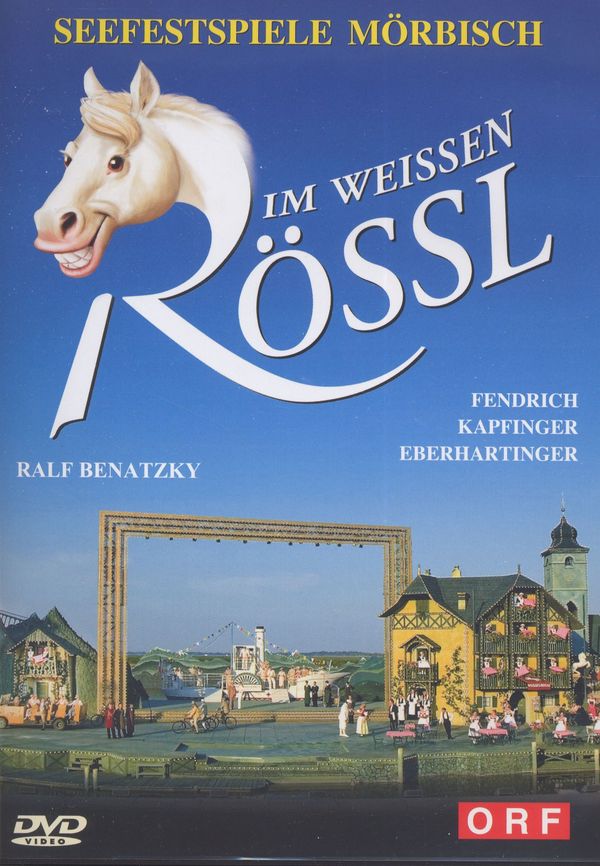

Moerbisch is a small lakeside town much visited as a summer holiday resort which has a huge auditorium for stage plays of various sorts.  The auditorium was packed for the performance I saw, as it usually is.  

For a start the 2008 Moerbisch performance was sponsored by ORF (Oesterreichischer Rundfunk; the Austrian State broadcaster) and they seem to have supported a resolution to make the show the definitive version of the operetta.  Money seems to have been no object.  They must have had a hundred "extras" among the performers and both the sets and the costumes were elaborate.  And they made a point of hiring singers who were also good actors and good looking.  The ladies were gorgeous and the character actors were brilliant in filling their parts.  

The many versions of the play over the years that have been performed do differ quite a bit, and this one also has its custom adaptations.  The play by now has been put on so often by so many that it has no "Masoretic" text.  The famous Robert Stolz "Goodbye" song, for instance (Adieu mein kleiner Gardeoffizier) is only heard in English language versions of this show.  In German, it occurred originally in an operetta Die lustigen Weiber von Wien, which now seems to be known only in a movie version ("The Merry Wives of Vienna") but it was later interpolated into movie versions of this show too.

It is difficult to pin down the period in which the show is set.  Kaiser Franz Joseph appears in it and he died in 1916 so one imagines that it is set in the late 19th century.  But "Dr Siedler" at one point uses prominently a 1950s rangefinder camera -- and there are other minor anachronisms -- such as the strange vehicle at the beginning of the show, not to mention the sportscar driven by Sigismund der schoene.  And the national anthem was not anything that Franz Joseph would have known.  In his day the tune was the old Haydn tune later appropriated by Germany for the Deutschland Lied.  The play premiered in 1897 so I assume it was meant to be contemporary and the anachronisms are the work of opinionated later artistic directors.

The plot

The plot is so complex, with everything intertwined, that I doubt that I can say anything useful about it. There is the main theme of the head waiter mooning after his very attractive landlady and the second theme of the lawyer being completely smitten by the gorgeous daughter of the haughty Berlin businessman -- but late in the show a third couple pop up, when a poor professor and his shy daughter encounter another very confident Berliner.  The complexity makes for a lot of laughs and some good arias. And there are, of course, three happy couples at the end.

Somewhat to my surprise and satisfaction the Austrian monarchy is treated fairly sympathetically.  I had expected a modern producer to satirize it in some way. The Kaiser (played by Harald Serafin) is presented as very frail but he probably was at the time the play was written.  And he is portrayed as mentally sharp and kindly.  He is also portrayed as thanking people a lot, which is true to life for Royalty.  And he very clearly seen by his subjects not just as an old man but as a symbol of the country,  which again is right.  The only element of satire I saw was to portray him wearing a helmet with bright GREEN plumes, but he has done that before so it apparently amuses him.

The cast

Intendant Harald Serafin as usual gave himself a part -- as Kaiser -- and he always does his parts well.  I think he is a naturally jolly person and something of that always comes through.  His nearly falling down the ladder was a good humorous touch. And the consternation that produced in his "subjects" was also very convincingly done. I think he did particularly well in this show.  Though his best performance in my view was in Das Land des Laechelns, where he portrayed wonderfully well the sadness of a father sending off his beautiful daughter to a dubious fate.  He normally does not give himself anything very tragic to portray but he can certainly do it.


And I wonder who wrote the wise words that he put in the hotel register.  They really were wise words IMHO.

Both the leading ladies were very easy on the eye.  Whoever thought of pouring the busty Zabine Kapfinger into a dirndl to play the part of the Wirtin (landlady) certainly knew what would look good.  Harald Serafin could not quite keep his eyes off her cleavage when she was leaning over him. Nor could I, for that matter. 

Trying to fend off her unwelcome admirer

Zabine Kapfinger is actually a pop and folk singer in real life so her voice was a little thin at times but she is a brilliant actress.  The show was hi-tech so we saw lots of close-ups of her face at times -- and all her expressions were spot-on for the role.  She played perfectly someone unlike her real self, I gather.  But perhaps not so unlike.  Below is a picture of her in real life with a lucky man -- her husband.  Note those Austrian blue eyes -- celebrated at length in the operetta itself (in the song, Die ganze Welt ist Himmelblau).


A small point about those blue eyes:  Blue eyes were at that time and place seen as a sign of  Treue -- Faithfulness, trustworthiness, loyalty.  You could rely on a person with blue eyes.  There is also a mention of blue eyes as loyal towards the end of Die Lustige Witwe by Lehar.  It has got me wondering if there is something in that. I can think of a reason why there could be something in it:  Blue eyes are cold-climate eyes and co-operation is probably more important to survival in such climates.  And trustworthiness is important to co-operation.

And the ultra-feminine Anja Katherina Wigger (pronounced Vigger) as Otti was rather mesmerizing in her looks and performance. I think a tall slim and attractive blonde who is also a good operatic soprano is something of a rarity.  Sopranos do tend to weight after a while.  And Wigger got her notes effortlessly.  So she is definitely one of my favourite operatic sopranos. Go to the 36 minute mark on the video and also the 46 minute mark to see her in action.  

I am actually rather soppy about Wigger.  I like the way she speaks as well as the way she sings. Her amused Ich eile ("I am hurrying") immediately before she encounters the  hilarious herd of cows sounds very expressive to me.  And her scream when she encounters the cows is as feminine as you can get.

And Sigismund der schoene, as the egotistical but aging playboy, was a manic touch.  And the poor Professor and his daughter in the luggage compartment was a good light-hearted touch of another sort: Self-confidence finally overcomes shyness.

But my favourite character in the operetta was Herr Giesecke.  He was the relentlessly negative curmudgeon who appeared throughout the show.  He had great laugh lines and Klaus-Dieter Lerche delivered them brilliantly.  I laughed at them every time even after I had heard them over and over again. There were jokes throughout the play but Herr Giesecke was basically one big joke.  All his appearances were funny.

The continuity people goofed with him, however.  In the course of  two days his moustache went from white to black and then back to white again!

The jokes

But a lot of what Herr Giesecke said was allusive.  You had to know what he was referring to in order to get the joke.  So I thought I might mention a few of those things from just one of his scenes.  The North/South rivalry in the German lands often seems to get some mention in operetta and here it was played out at length.  In Germany the stern "Prussians" (Northerners) look down on the more relaxed Southerners but the Southerners don't care one bit about that.  They know that they have the culture so the North is welcome to its soldiers.

So Herr Giesecke made a great point out of his view that he should have gone to Ahlbeck rather than the Salzkammergut (Austria's beautiful lake district).  Ahlbeck is an island just off Germany's Baltic coast and the Baltic is a pretty rough body of water.  It is grey and stormy a lot of the time.  The Baltic coast is reasonably passable in summer but nothing like the lush Salzkammergut.

And in denying that the Salzkammergut was better than North Germany he made some hilarious comparisons.  In saying how regions near Berlin where he lives were as good as areas in the Salzkammergut he said at one point: "What about Spandau?".  What about Spandau indeed!  Spandau is a suburb of Berlin and I am sure it is well kept but the only thing notable that I know about it is that a large prison was long located there (now torn down).  

And he also praises the Stoelpchensee as comparable to the Austrian lakes.  The Stoelpchensee is one of a string of small lakes connected by canals to the South of Berlin.  But they are often not much wider than the canals as far as I can see.  Again a foolish comparison.  And one of his best lines comes after he praises the Lueneburger Heide, a much loved heathland area of North Germany.  The Wirtin asks him:  Do they have mountains there?  He replies, "No; but if we did they would be higher"!  

That was quite a big and jolly scene but he crops up later in the play as well.  At the very end when all the couples are happily together he appears and says that in Berlin they would call that knutschen -- "smooching".

Other notes

Something the Ober (head waiter) said at one point  is also rather obscure.  He asks Herr Giesecke if he wants to dudeln.  Dudeln is the Viennese word for yodelling but in slang it means to have a few (alcoholic) drinks.

And in her yodelling song, the Wirtin (Kapfinger) mentions her beloved  Steiermark, a beautiful part of Austria's large Alpine region -- and much beloved of the still remembered Erzherzog Johann (Archduke John), who died in 1859.  In English we call the place "Styria"?  How ugly!  And how needless.  There is nothing hard to pronounce in the original name.  If we can say Denmark, we can say Steiermark.

And all performances at Moerbisch seem to incorporate a complaint about the local mosquitoes. It is a bit of a game to watch for the mention of them to pop up.  There were two mentions of them on this occasion:  A penalty of the Moerbisch stage being located on the marshy shore of a lake, of course.  Pest control can obviously not quite cope.

I think I have finally got the chorus of the theme song into my head but how long the words will stay there is a question.  The words are:

Im "Weissen Rössl" am Wolfgangsee, 
Da steht das Glück vor der Tür, 
und ruft dir zu: "Guten Morgen, 
tritt ein und vergiß deine Sorgen!"

But I think I should just note something about the German nicknames in the play for those who know no German.  German constructs its affectionate nicknames in a way rather different from what we do.  With us a "Joe" or "Joseph" becomes "Joey".  But in Southern German it becomes "Seppl".  How come?   Southern German concentrates on the last part of the name so the "sep" at the end of Joseph or Josef has the diminutive "l" added to make "seppl".  And Josepha in the play becomes "Pepi" or "Peperl" and Leopold becomes "Poldi".

And North German does it another way again. So "Klara" becomes "Klaerchen".  The play includes both Northerners and Southerners so you see both approaches in it. 

Finally, perhaps I should apologize for adopting the English custom of referring to Im weissen Roessl  as an operetta.  The credits rightly describe it as a Singspiel, a play with singing.
  

APPENDIX:

The words and translation of "Mein Liebeslied muss ein Walzer sein"

 Was mein Herz zu sagen hat, What my heart has said,
Fühlst auch du, you feel too;
Was die Uhr geschlagen hat, what hour the clock has struck,
Weisst auch du. you know too.
Und hast du kein Ohr für mich, And if you will not listen to me,
Finde ich keine Ruh’, I shall find no peace,
Drum hör zu, drum hör zu. so listen, listen.
Sag’ ich es in Prosa dir, klingt es kühn. If I say it to you in prose, it sounds bold.
Das ist nicht das Rechte für mein Gefühl. That is not right for my feelings.
Aber, wenn die Geigen zärtlich für mich fleh’n But, if the violin sweetly pleads on my behalf,
Wirst du gleich mich versteh’n: you will understand me:
Mein Liebeslied muss ein Walzer sein, My love song must be a waltz,
Voll Blütenduft und voll Sonnenschein. full of floral scents and sunshine.
Wenn beim ersten du, ich mich an dich schmieg, The first time that you and I cuddle up,
Braucht mein Herz dazu süsse Walzermusik. my heart will need sweet waltz music.
Mein Liebeslied muss ein Walzer sein, My love song must be a waltz,
Der süss berauscht, wie Champagnerwein. sweetly intoxicating, like champagne.
Und das Lied, das dir sagt, „Ich bin dein“, And the song which says, ‘I am yours’
Kann doch nur ein Wiener Walzer sein. can only be a Viennese waltz.
Wenn der Liebe Lust und Schmerz einen packt, When Love bundles pleasure and pain together into one,
Schlägt ein jedes Menschenherz seinen Takt! every human heart beats its own rhythm!
Jeder singt für sich partout Everyone everywhere sings their own song
Und auch der Text dazu heisst: and that’s what the old saying means:
„Chacun à son goût!“ ‘Each to their own!’
Einer gibt den grössten Reiz der Gavott’ One is most attracted by the gavotte;
Und der and’re seinerseits liebt mehr flott! another prefers, for his part, to love more quickly!
Und es wechseln Moll und Dur, And it switches minor and major keys;
Ja, c’est l’amour. Aber ich sage nur: yes, that is love. But I say only this:
Mein Liebeslied… My love song must be a waltz…


And I can't resist putting up here the words for the wonderful "Goodbye" song:

Und eines Tages mit Sang und Klang Da zog ein Fähnrich zur Garde Ein Fähnrich, jung und voll Leichtsinn und schlank Auf der Kappe die goldene Kokarde

Da stand die Mutter vor ihrem Sohn Hielt seine Hände umschlungen Schenkt ihm ein kleines Medaillon Und sie sagt zu ihrem Jungen:

Adieu mein kleiner Gardeoffizier, Adieu, Adieu Und vergiss mich nicht Adieu mein kleiner Gardeoffizier, Adieu, Adieu. Sei das Glück mit dir

Stehe gerade, kerzengerade Lache in den Sonnentag Was immer gescheh'n auch mag Hast du Sorgenminen, fort mit ihnen Ta-ta-ra-ta-ta Für Trübsal sind andere da

Adieu mein kleiner Gardeoffizier, Adieu, Adieu Und vergiß mich nicht Adieu mein kleiner Gardeoffizier, Adieu, Adieu Sei das Glück mit dir Adieu, Adieu mein kleiner Offizier, Adieu


Tuesday, March 10, 2015


Aida: A most "incorrect" opera

When it comes to stage performances (plays, operettas, opera) I like some attempt at authenticity to be made.  Both the sets and the costumes should show some attempt to represent the time and place in which the play is set.  Once upon a time, one could automatically expect that  -- but no more.  Minimalist sets and costumes -- and even anachronistic set and costumes -- seem to be "in".

I can abide minimalism.  It cuts costs and opera is expensive to stage.  But anachronism gets my goat. A recent performance of Handel's Giulio Cesare at Glyndebourne, for instance, had revolvers and steamships in ancient Egypt!  A malediction upon the producer!  I imagine that anachronism is supposed to be clever or entertaining but to me it is just incompetent.

So I greatly appreciate the Metropolitan opera in New York.  They must be the most lavishly funded opera house in the world. When the script requires dancing, they even have their own ballet company to do the honours.  It makes for very high quality staging. And they do a lot of authentic staging.  I don't go there but I buy their DVDs. Buying their stuff helps with their stratospheric costs, of course. And you see a lot more with a DVD than you would see as part of a live audience anyway.

So I was keen to see their production of a famous opera -- Verdi's "Aida".  And I was not disappointed.  The sets were magnificent and very evocative of ancient Egypt. And the costumes were elaborate. There was even a passable representation of the double crown of upper and lower Egypt on the Pharaoh in some scenes.

But I am glad I bought the DVD.  If the performance is  available now via YouTube, I predict that it will soon be taken down.  Why?  Because the performance took place in 1989 and it uses -- horror of horrors -- BLACKFACE.  Both the alleged Ethiopian princess and her alleged Ethiopian father were clearly Caucasian beneath the blacking. The princess was in fact played by Aprile Millo, an American operatic soprano of Italian and Irish ancestry.  I am putting up below an image of her as she appeared in the Met's "Aida".  But it was an excellent performance all round with the famed Placido Domingo as Radames, the Egyptian hero.

And why shouldn't the Met use Millo in their opera?  She is a regular there with a magnificent voice -- and a bit of blacking obviously seemed to them enough to give authenticity to the performance.

How odd it is that something that was normal and unquestioned just a quarter of a century ago is now routinely denounced.  The world is in a fit of hysteria about proper use of language and how the world is represented in general.


Some real Ethiopians below


Thursday, February 26, 2015


"The pirates of Penzance" as satire

And some surprising political implications

I first saw "Pirates" when I took my (then) teenage son to see a well-reviewed production of it here in Brisbane.  I am not at all a Gilbert & Sullivan devotee -- the profundity of Bach is my musical home -- but I know the G&S works as classics of entertainment. So I felt that I should help along my son's musical education.

Anyway, you see far more of any Singspiel on DVD than you do in a theatre audience so I recently acquired a DVD of "Pirates". And, watching it, I did see that it had elements of satire. "Pirates" is not of course satire an sich.  It is simply the madcap humour of W.S. Gilbert ably abetted by the great musical abilities of Arthur Sullivan. I see it as a forerunner of other madcap British comedies such as those of  Mr. Bean,  the Goons and the Pythons.

What differentiates comedy and satire is of course that satire is humour targeted at someone as a form of criticism.  It is deliberately didactic.  But straight comedy can teach lessons too, if only in an incidental way.  And I see some of that in "Pirates".  Perhaps a surprising one that I see is in the song of the "modern major general", now a widely treasured bit of fun.  What Gilbert was doing in that song was referring to something that no Leftist would believe: That  British military officers  were and are often quite scholarly in various ways.  That's not at all universal but not infrequent either.  Even an RSM will often be a man of unexpected depths.  The Sergeant Major of my old army unit  was/is in fact a fan of Bach and Palestrina (nothing to do with Palestine).   And the only Wing Commander (airforce) I know is a voracious reader with a wide knowledge of history.

Captain Cook, the 18th century British discoverer of much in the Pacific is a very good example of a scholarly military man.  His discovery of the cure for scurvy alone ranks him as a distinguished scientist and his practice of quarantine was exemplary for the times.

But a much less well known but quite commendable 18th century military man with scientific interests was Watkin Tench,  an officer in His Majesty's Marine Forces.  He was posted to the new British colony in Australia in its very earliest days, then a hardship posting.  You could lose your life just getting there and back.  So he was no elite soldier and was actually from a rather humble background.  His interest was meteorology and he brought with him the latest Fahrenheit thermometer. He kept a meteorological diary that included  observations from his thermometer taken four times daily in a sheltered spot -- exemplary practice even today.

And his record of the Sydney summer of 1790 is particularly interesting.  It was very hot.  There were even bats and birds falling out of the trees from the heat.  And his thermometer readings tell us exactly how hot.  So we have both readings from a scientific instrument and behavioural observations that validate the readings:  Very hard to question.  And the solidity of his data is very useful in exposing the liars of Australia's current Bureau of Meteorology.  They have got the virus of Warmism in their heads and are always claiming that Australia in whole or in part is currently experiencing a "hottest" year.  And they exploit the fact that Sydney does occasionally have some very hot summers.  But Tench's data show that such summers go back a long way in Sydney  and hence cannot be attrributed to nonsense about the current CO2 concentration in the atmosphere. The only additions to atmospheric CO2 from the Australia of Tench's days would have been the product of breathing by various living creatures.  There was not even any reticulated electricity anywhere in Australia or anywhere else at that time.

So in the famous song of the modern Major General, Gilbert was simply doing an amusing exaggeration of a real phenomenon, a military man with scientific interests, probably one better known to the British public when Gilbert wrote around 100 years ago.

I actually find prophetic Gilbert's treatment of the police ("When the foeman bares his steel").  The police have always been greatly  respected in Britain -- though that must have eroded in the last two decades -- but Gilbert defies that.  He makes fun of the police and portrays them as cowards.  As a portrayal of modern British police forces that would not be too far astray.  Did Gilbert have some experience of police to lead him to the derogatory view he took of them? I suspect it. In Strange Justice and Political Correctness Watch you will certainly find a wealth of instances of reprehensible behavior by the British police of today.

And the other police song ("A Policeman's Lot Is not a Happy One") is also very modern, expressing sympathy for offenders and a reluctance to arrest them.  Gilbert is actually a rather good prophet.

And the pirate King's assertion that "compared with respectability, piracy is comparatively honest" is also refeshingly cynical.  Commenters on modern-day "crony capitalism" in America will nod approval. And the decision of the daughters to "talk about the weather" rather than pry is quintessentially British. And the homage to Queen Victoria was also an appropriate contemporary reference but greatly exaggerated, of course.  It too could be seen as mocking by a modern audience

And I must pay tribute to the performance (in the production I have) to the singing of Linda Ronstadt.  Better known as a popular singer she is also a superb soprano and greatly ornaments the role of the Major General's daughter Mabel.


Linda Ronstadt as Mabel. Amid the total craziness of a W.S. Gilbert libretto she produces superb music. I cannot speak highly enough of her performance

FOOTNOTE:  I use the German word Singspiel above because there is no equivalent in English.  It means a "sung play" and refers to any musical performance (from Mozart's Zauberfloete ("Magic Flute") to Benatzky's beloved Im Weissen Roessl ("White Horse Inn")) that includes both spoken and sung dialogue.  A Hollywood musical such as "Showboat" is also a Singspiel.  English has a horde of words borrowed from other languages so it seems regrettable that a useful word like Singspiel has not been borrowed too.


Tuesday, February 24, 2015


Salzkammergut


"Salzkammergut" has a rather harsh sound, does it not?  In the correct German pronunciation it sounds even harsher!

But I have recently been watching a DVD of "Im weissen Roessl" (in German with English subtitles), usually translated as "The  White Horse Inn".  It is set in the Salzkammergut and I think most people at the end of the performance would have developed a resolution that one day they too must see the Salzkammergut.

The literal meaning is "Salt office estate" -- a name that goes back to medieval times when salt was very valuable.  And the Salzkammergut included a salt mine.  There was even a fort built to protect the mine -- a fort called "Salt Fort", or, in German Salzburg.  That fort has given its name to the town near it, now better known as the birthplace of Mozart.

So the Salzkammergut was originally the area of Austria that came under the jurisdiction of the Salt Office, the Austrian  government department dealing with all matters salty.  It is not usually translated literally however.  It is usually rendered into English as "The Austrian Lake District" and it does have a great reputation for beauty.  The salt mine is only a small part of the story now.  It is now a tourist attraction.


A view of Hallstatt in the Salzkammergut

The chorus from the theme song of "Im weissen Roessl":

Im "Weissen Rössl" am Wolfgangsee,
Da steht das Glück vor der Tür,
und ruft dir zu: "Guten Morgen,
tritt ein und vergiß deine Sorgen!"


And here is the whole Salzkammergut song:

1. Im Salzkammergut da kann man gut lustig sein
Im Salzkammergut, da kammer gut lustig sein
Wenn die Musi spielt, holdrio.
Im Salzkammergut, da kammer gut lustig sein,
So wie nirgendwo, holdrio.

Es blüht der Holunder
Den ganzen Sommer mitunter,
Jedoch die Liebe,
Die blüht s' ganze Jahr.
Im Salzkammergut, da kammer gut lustig sein,
Ja, das war schon immer so, holdrio.

2. Die ganze Welt ist Himmelblau (von Robert Stolz)
Die ganze Welt ist himmelblau
Wenn ich in deine Augen schau'
Und ich frag dabei: Bist auch du so treu
Wie das Blau, wie das Blau Deiner Augen

Ein Blick nur in dein Angesicht
Und ringsum blüht Vergissmeinnicht
Ja, die ganze Welt machst du süsse Frau
So blau, so blau, so blau

3. Es muss was Wunderbares sein
Es muss was wunderbares sein
von dir geliebt zu werden
denn meine Liebe, die ist Dein
so lang ich leb auf Erden

Ich kann nichts schöneres mir denken
als dir mein Herz zu schenken
wenn du mir Dein's dafür gibst
und mir sagst, dass auch Du mich liebst.

4. Mein Liebeslied muss ein Walzer sein (von Robert Stolz)
Mein Liebeslied muss ein Walzer sein,
voll Blütenduft und voll Sonnenschein.
Wenn beim ersten du ich mich an dich schmieg,
braucht mein Herz dazu süsse Walzermusik.

Mein Liebeslied muss ein Walzer sein,
der süss berauscht, wie Champagnerwein.
Und das Lied, das dir sagt, ich bin dein
kann doch nur ein Walzer sein,
kann doch nur ein Walzer sein.
Und das Lied, das dir sagt, ich bin dein,
kann doch nur ein Liebeswalzer sein.

5. Im weissen Rössl am Wolfgangsee
Im weissen Rössl am Wolfgangsee
da steht das Glück vor der Tür,
und ruft dir zu: "Guten Morgen,
tritt ein und vergiss deine Sorgen!"

Und musst du dann einmal fort von hier,
und tut der Abschied dir weh;
denn dein Herz, das hast du verloren
im "Weissen Rössl" am See!

Just a sampling of the operetta below (not the version I have but well done).  Wait for the final chorale


And below is the ultra-feminine Anja Katharina Wigger and friend singing the "so blau" song.  If the dynamic linking does not work, go to the 36 minute mark on the video. There must be few operatic sopranos as good-looking as she is. There is some good video of her from the 46 minute mark too.


Wednesday, January 28, 2015


Swan Lake

The 2009 performance by the Australian ballet with choreography by Graeme Murphy

It is amazing how well choreographers can convey a story without words.  The sets were rather minimalist but fitted in well enough.  And Tchaikovsky's music is of course always superb.  Once again the men were mostly in modern suits rather than in the 19th century garb that Tchaikovsky would have envisioned but it was not too distracting in the circumstances.

When people comment on Swan Lake they mostly comment on the dancing, not the story.  Yet the story is an engaging one.  It is the old old story of a married man and the "other" woman.  I rather related to that for reasons that are probably too indelicate to discuss.  I have been cheerfully monogamous for most of my life but there were other episodes in times past.  And I rather liked the "other" woman in the ballet.  I would have had her.

But there was some fabulous dancing.  I didn't realize the heights to which Australian dancers could rise. I found the asylum scene in Act 2 disturbing.  Knowing of the real life abuses in psychiatric institutions it was a bit too real for me.  And the exaggerated wimples on the nuns were both amusing and yet appropriate somehow.  Kudos to the costume department.

The scene when the newly-wed wife catches her husband kissing the other woman amused me.  In response to being caught the danseur does the strangest dance in order to get himself out of the situation.  It reminded me of John Cleese in the Ministry of Silly Walks.  It rather cracked me up.  I imagine it was supposed to portray his agony of soul or some such but I could not take it seriously at all.

But definitely a credit-worthy production overall.

Monday, January 19, 2015


Handel's Giulio Cesare at Glyndebourne

I have been watching a set of DVDs of a 2005  performance of Giulio Cesare at Glyndebourne and there is virtually nothing about the staging that I agree with.  The music was fine and the singers talented but the artistic director of the performance gave the impression of being under the spell of the deplorable modern urge to be "creative" about the staging.

And, sadly, his creativity was so impoverished that he mistook anachronism for originality.  He seemed to think that having airships and steamships in the background of an opera set in ancient Egypt was somehow clever -- not to mention the revolvers, rifles, sunglasses, cocktail dresses and pith helmets. Why is deliberate anachronism clever? I have no idea.   There was zero attempt to present the life and times of Caesar and Cleopatra authentically.

And particularly in Act 3 a lot of the arias were sung with the actors lying on the ground. How is that for moronic choreography? Most of the live audience would have been able to see nothing at such times.

Not for me I am afraid.  People go to a stage show to see the creativity of the author and that is what the artistic director should be trying to bring out -- not display some petty creativity of his own

I watched the very extensive "after-notes" on the DVD and they did feature wide-ranging comments by David McVicar, the distinguished Scottish artistic director.  And although I disagree with just about everything he did, I have to concede that he is a man of great sensitivity and sensibility, in a notably "camp" way.

He was obviously devoted to the work, which is admirable, but clearly saw his role as making Handel more "accessible" to modern audiences.  But he seems to have had a very dim view of his audience.  He seems to have seen them as simpletons who need to be talked down to, with schoolboy humour, if necessary.  At Glyndebourne??

He seems to have thought that largely Edwardian costumes, props etc. accomplished that.  And he had no idea of military deportment.  He had some soldiers moving at one stage as if they had pooed their pants! And what on earth was achieved by having pictures of WWI battleships, blimps and RMS "Titanic" in the background? Arty people just get too detached, sometimes, and McVicar being homosexual probably isolated him even more than usual.

How could he be so totally unaware of the great success the BBC has had with costume dramas?  Togas and Egyptian finery would have been both in keeping with the story and enjoyed by the audience. And there was no lack of precedent for that approach.  Aida is often done with an approach to Egyptian sets and costumes.  Most of the props and costumes needed were probably already in store at Glyndebourne.

And the voices were so unbalanced!  Maltman was the only decent male voice in the show.  The rest were females plus one counter-tenor.  Was that supposed to be politically correct, or something?  It was certainly tiring and ridiculous artistically.  I very much like soprano voices but you can have too much of a good thing.

And, sadly, that was an excellent chance to be original that was missed.  When Handel wrote the opera, castrati were all the rage so the songs of some male figures were given in a high key that only women and counter-tenors can now reach.  So Caesar was played by a woman in order to be faithful to the notes as written by Handel.  I deplore trouser roles generally but a female Caesar is frankly ridiculous.  Now that the fashion for castrati is long gone, it would surely have been desirable to drop all the male parts down an octave or two and have men in men's parts.

Can do better Glyndebourne.  Maybe they could re-run the opera (minus the anachronisms of course) with Caesar as a bass and the other males as baritones.  That alone would generate great excitement, I fancy


From the opening scene

I would be remiss if I did not record my appreciation of the performances by Christopher Maltman and Danielle de Niese in the opera.  Maltman is multi-talented.  He is a singer who is also an accomplished acrobat!  And he acts well too.  His representation of Achilla represents a military man well.  It takes a man to portray a man!  Shockingly "sexist" of me, I know.

And the unfailing energy of Australian singer Danielle de Niese as Cleopatra is also impressive. She had some long arias to sing but her rich soprano voice never faltered and her facial expressions mirrored every word she sang.  She was no Cleopatra in looks and her dancing was very basic but her singing was awesome. She is a mixed-race ("Burgher") Sri Lankan by ancestry but was born and bred in Australia.

I particularly enjoyed Cleopatra's triumphant aria towards the end of Act 3. It is probably not one of the "great" soprano arias but it is certainly one of the longest. And with Handel composing it is superb as well as long.  The immediate and huge applause that comes at the end of the aria is amply justified.

As I write this I am listening to the energetic and marvellous brass fanfare that introduces the end of the opera. Quite incredibly good. Handel never lets us down.


The whole opera is online here:


Or here: https://www.youtube.com/watch?v=an_SUvpylso

A couple of good excerpts:


">

Friday, January 2, 2015


Psalm 23

The most esteemed Psalm would have to be Psalm 23:  "The Lord is my shepherd ...".  It is a wonderful psalm that has been set to music many times.  Bach even did a superb version.  But it is not only the music but also the words that changes. Hebrew poetry does not come out as poetry when you translate it directly into English.  So you have to rejig the words in some way to make the psalm singable in English.

I was not fully aware of that.  I was aware that the version in the Anglican prayer book was different from the version in the King James Bible but assumed that everybody used the prayer book version.  I could not have been more wrong.  I keep both books on my table in front of me so I checked.  The prayer book version is TOTALLY unsingable and the King James version is not much better.

So where do we get the version in our hymn books?  We get it from Crimond.  Crimond is a small town in Northern Scotland where the religion is pretty fundamentalist, meaning that they take the Bible, including the psalms, pretty seriously.  I was once one of them so I like them for that.  And they have their own Scottish psalter (book of psalms in singable form): The Scottish Psalter of 1650, to be precise.  And the words of psalm 23 in that book were set to music by a young Scotswoman who lived in Crimond. It proved a very popular setting so the tune we all now sing is known as Crimond.  Below are the words concerned:

The Lord's my Shepherd, I'll not want.
He maketh me down to lie
In pastures green; He leadeth me
The quiet waters by.

My soul He doth restore again;
And me to walk doth make
Within the paths of righteousness,
Even for His own Name's sake.

Yea, though I walk in death's dark vale,
Yet will I fear none ill;
For Thou art with me; and Thy rod
And staff me comfort still.

My table Thou hast furnished
In presence of my foes;
My head Thou dost with oil anoint,
And my cup overflows.

Goodness and mercy all my life
Shall surely follow me;
And in God's house forevermore
My dwelling place shall be.


I am still very responsive emotionally to the Protestant religion of my youth so it still gives me great joy to listen to that